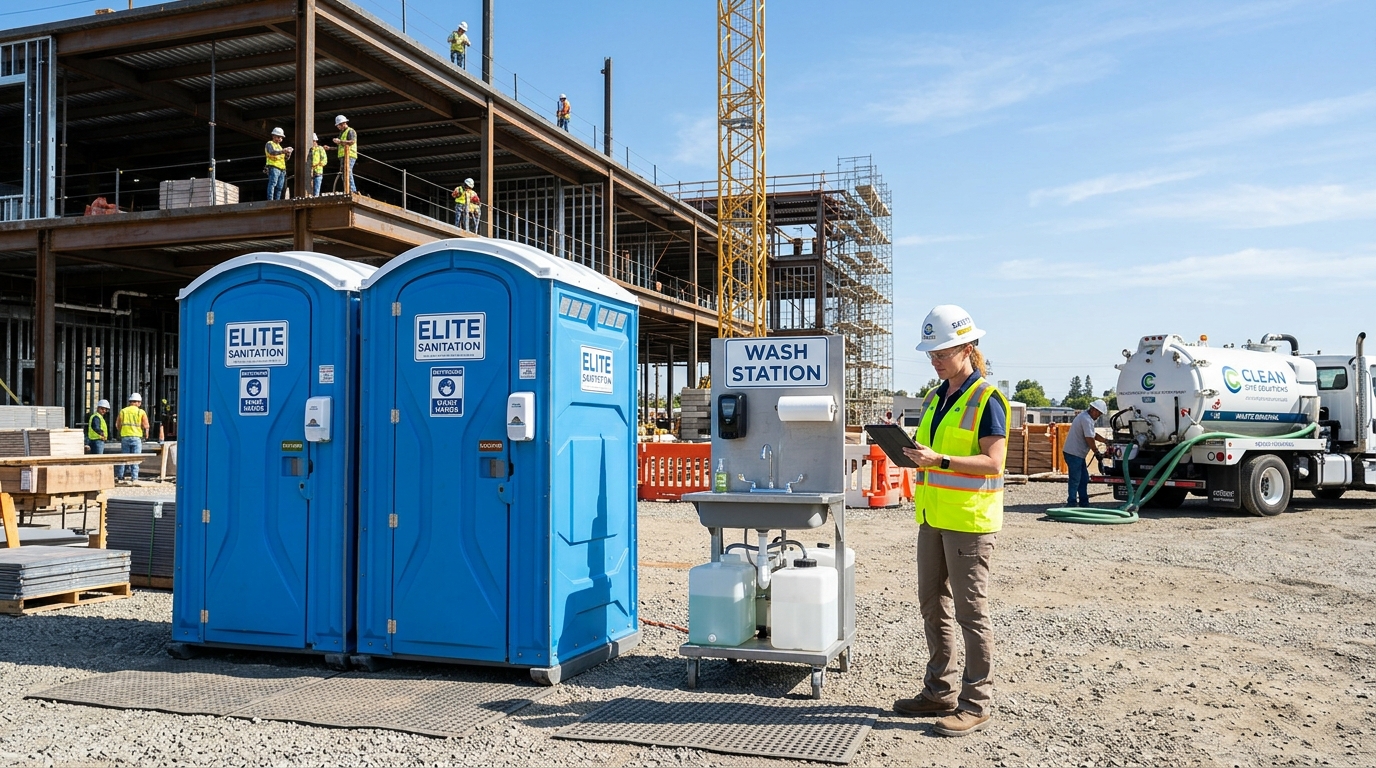
For commercial general contractors and portable sanitation rental providers, jobsite sanitation is far more than an employee amenity—it is a federally mandated legal standard governed strictly by OSHA. Overlooking restroom ratios, failing to pump tanks on schedule, or missing soap at handwash stations can immediately trigger stop-work orders and steep fines exceeding $16,000 per serious violation.
In this comprehensive guide, we unpack the federal regulations under OSHA 29 CFR 1926.51, provide the official worker-to-toilet reference table, analyze mandatory cleaning intervals, and demonstrate how portable restroom fleet operators and GCs protect themselves with tamper-proof digital compliance logs.
1. The Federal Standard: Understanding OSHA 29 CFR 1926.51
Federal OSHA enforces jobsite sanitation under Title 29 of the Code of Federal Regulations, specifically 29 CFR 1926.51 (Sanitation). Unlike permanent commercial buildings governed by local plumbing codes, construction jobsites present dynamic conditions where the number of active trades, subcontractors, and laborers changes week by week.
The core OSHA mandate requires employers to provide clean, adequately stocked, and readily accessible toilet facilities for all employees from the initial groundbreaking phase until project completion. Specifically, the regulation stipulates that:
- Toilet facilities must be supplied in adequate numbers based on peak daily labor headcount.
- Facilities must be maintained in a clean, sanitary, and functional condition at all times.
- Toilets must be located within a reasonable travel distance (generally interpreted as within 10 minutes walking distance or 300 to 400 feet).
- Adequate supplies of toilet paper with an appropriate holder must be maintained inside every stall.
- Each unit must offer complete visual privacy and a functioning interior latch or door lock.
2. OSHA Construction Restroom Ratios (The Official Formula)
How many portable toilets does a construction site actually need? OSHA outlines a tiered scale under Table D-1 of 29 CFR 1926.51(c)(1). Failing to deploy sufficient units when multiple framing, electrical, or concrete trades arrive on site is one of the most common citations issued during unannounced safety inspections.
| Number of Employees on Site | Minimum Required Toilets | Urinal Substitution Allowance |
|---|---|---|
| 1 to 20 workers | 1 Toilet Facility | Not permitted for single unit |
| 20 to 199 workers | 1 Toilet Seat + 1 Urinal per 40 workers | Urinals may replace up to 50% of additional toilet seats |
| 200 or more workers | 1 Toilet Seat + 1 Urinal per 50 workers | Urinals may replace up to 50% of additional toilet seats |
Practical Example Calculation:
If your jobsite averages 85 active workers during peak phases, OSHA requires: 1 unit for the first 20 workers, plus 2 additional toilet/urinal combinations for the remaining 65 workers. Therefore, your site must provide a minimum of 3 to 4 functional units (e.g., 2 standard toilet stalls and 2 urinal stations or combined portable restrooms).
3. Servicing Frequency: How Often Must Portable Toilets Be Pumped?
A frequent misconception among general contractors is that simply renting the minimum number of plastic cabins satisfies OSHA regulations. However, OSHA standard 29 CFR 1926.51(a)(6) states that facilities must be maintained in a clean, sanitary condition. If a toilet tank reaches full capacity, produces noxious odors, or runs out of chemicals and toilet paper, it is legally deemed "unavailable" under OSHA enforcement guidelines.
According to the Portable Sanitation Association International (PSAI) industry guidelines:
- Standard 40-Hour Work Week (1 to 10 workers per unit): Requires a minimum of once-per-week thorough servicing (waste pump-out, pressure wash interior, recharge holding tank with fresh deodorizer/biocide, and restock supplies).
- Multi-Shift or Overtime Operations (Over 40 hours/week): Servicing frequency must be doubled to twice-per-week or converted to on-demand daily servicing.
- Summer / Extreme Heat Conditions: High ambient temperatures accelerate bacterial decomposition in waste holding tanks, requiring more frequent biocidal chemical treatments and pump-outs to prevent airborne bio-aerosol accumulation and foul odor complaints.
The 2026 OSHA Penalty Reality:
Federal OSHA violation penalties are adjusted annually for inflation. In 2026, a single "Serious Violation" for inadequate jobsite sanitation carries a maximum statutory penalty of over $16,131 per violation. Repeat or willful failure to maintain clean sanitary facilities can escalate past $161,323.
4. Mandatory Handwashing Stations: Soap, Water & Towels
Can portable restrooms rely solely on alcohol-based hand sanitizer bottles? Under federal OSHA construction standards, the answer depends on the site hazards.
While alcohol hand rub is widely accepted for basic restroom sanitization on low-hazard job sites, OSHA 29 CFR 1926.51(f) explicitly mandates running water, soap, and single-use towels whenever workers handle hazardous materials, including:
- Paints, solvents, and adhesives containing volatile organic compounds (VOCs).
- Silica dust from concrete grinding, cutting, or masonry work.
- Lead paint remediation or asbestos abatement zones.
- Toxic sealants, epoxies, and chemical fertilizers.
Hand sanitizers do not neutralize toxic dusts, lead particulates, or oil-based residues. Leading sanitation fleet providers recommend deploying self-contained 2-station or 4-station foot-pump handwashing sinks directly adjacent to portable toilet banks to maintain full compliance.
5. Accessibility, Gender Privacy & Lockbox Security Rules
Modern jobsite compliance also encompasses equal access and personal safety considerations:
Visual Privacy and Locking Mechanisms
Every portable restroom must be equipped with an interior mechanical latch or deadbolt. If a door latch is broken, jammed, or damaged by winds, the unit fails OSHA privacy standards and must be tagged "Out of Service" until repaired by the service technician.
Gender-Separate Restrooms vs. Single-Occupant Stalls
OSHA permits portable toilets to be used as unisex restrooms only if they are single-occupant rooms that can be locked from the inside. On large commercial projects with multiple designated multi-stall trailers or clustered portable banks, clearly marked separate stalls for male and female personnel are recommended to support workforce inclusivity and respect privacy.
Physical Distance and Safe Travel Paths
Portable toilets placed in remote corners of multi-acre industrial campuses or across active heavy equipment traffic lanes violate OSHA accessibility rules. Toilets should be situated on dry, stable, level grade with unobstructed pedestrian footpaths, away from overhead crane drop zones and excavation trenches.
6. The Audit Defense: Why Digital Proof Logs Are Essential
When an OSHA inspector arrives at the jobsite trailer unannounced or responds to a subcontractor complaint, how do you prove that your portable restrooms were properly serviced, sanitized, and restocked on schedule?
Relying on weather-beaten paper cards stapled to the inside plastic door is a liability. Paper logs frequently get soaked by pressure washers, defaced by graffiti, or torn down by wind. In a compliance dispute, paper records provide zero cryptographic proof of when the technician was on site.
How Digital Fleet Logs Protect GCs and Service Operators:
- Cryptographic GPS Stamping: When a pump truck technician arrives, the mobile app captures the exact latitude and longitude coordinates directly on site, verifying that the truck was physically positioned next to the unit.
- High-Resolution Before/After Photos: Digital photo logs demonstrate clean bowl conditions, replenished toilet paper rolls, and functional soap dispensers before the technician departs.
- 1-Tap Monthly Compliance Dossier: General contractors can generate an audit-ready PDF dossier containing all date-stamped cleanings, technician names, and digital timestamps to present to safety auditors within seconds.
Keep Every Jobsite 100% OSHA Compliant
Eliminate compliance risk and paperwork headaches. PortaPotty Log empowers route drivers to document GPS-verified cleanings in under 30 seconds and exports instant compliance dossiers for general contractors.
Start Free Fleet Trial →7. Frequently Asked Questions (FAQ)
Are portable toilets required to have handwashing stations?
OSHA requires adequate cleansing facilities. Where employees handle hazardous substances like concrete silica dust, solvents, or lead, dedicated handwashing facilities with running water, soap, and individual towels are mandatory. For general sanitary use, alcohol hand rub stations are permitted if maintained in working order.
How close must portable restrooms be to construction workers?
OSHA regulations require toilets to be readily accessible. Industry and legal standards interpret this as within a 10-minute round-trip walk (approximately 300 to 400 feet). On multi-story high-rise buildings, portable restrooms or elevator access should be arranged so workers do not spend excessive transit time accessing facilities.
Who is legally responsible for OSHA restroom compliance: the GC or the rental company?
Under OSHA's Multi-Employer Citation Policy, the General Contractor (Creating/Controlling Employer) holds legal responsibility for ensuring sufficient units and sanitation on site. However, the portable restroom provider is contracted to execute the servicing schedule. Having digital proof of service protects both parties from mutual disputes and regulatory fines.
Can an employer restrict workers from using the restroom on a job site?
No. OSHA's sanitation standard explicitly prohibits employers from placing unreasonable restrictions on bathroom use. Workers must be granted prompt access to toilet facilities whenever natural biological needs arise without fear of retaliation or docked pay.